Image Loading
Movie posters are visual-heavy assets, so sizing and lazy loading improve perceived speed.

Recommendation Web App
Movie Suggestion helps users move from vague viewing intent to a practical watchlist. It is designed for people who know the mood, genre, or style they want but do not want to scroll endlessly through catalogs.
Type
Recommendation Web App
Timeline
Built as a focused recommendation product with emphasis on discovery, filtering, and quick feedback.
Focus
Product engineering
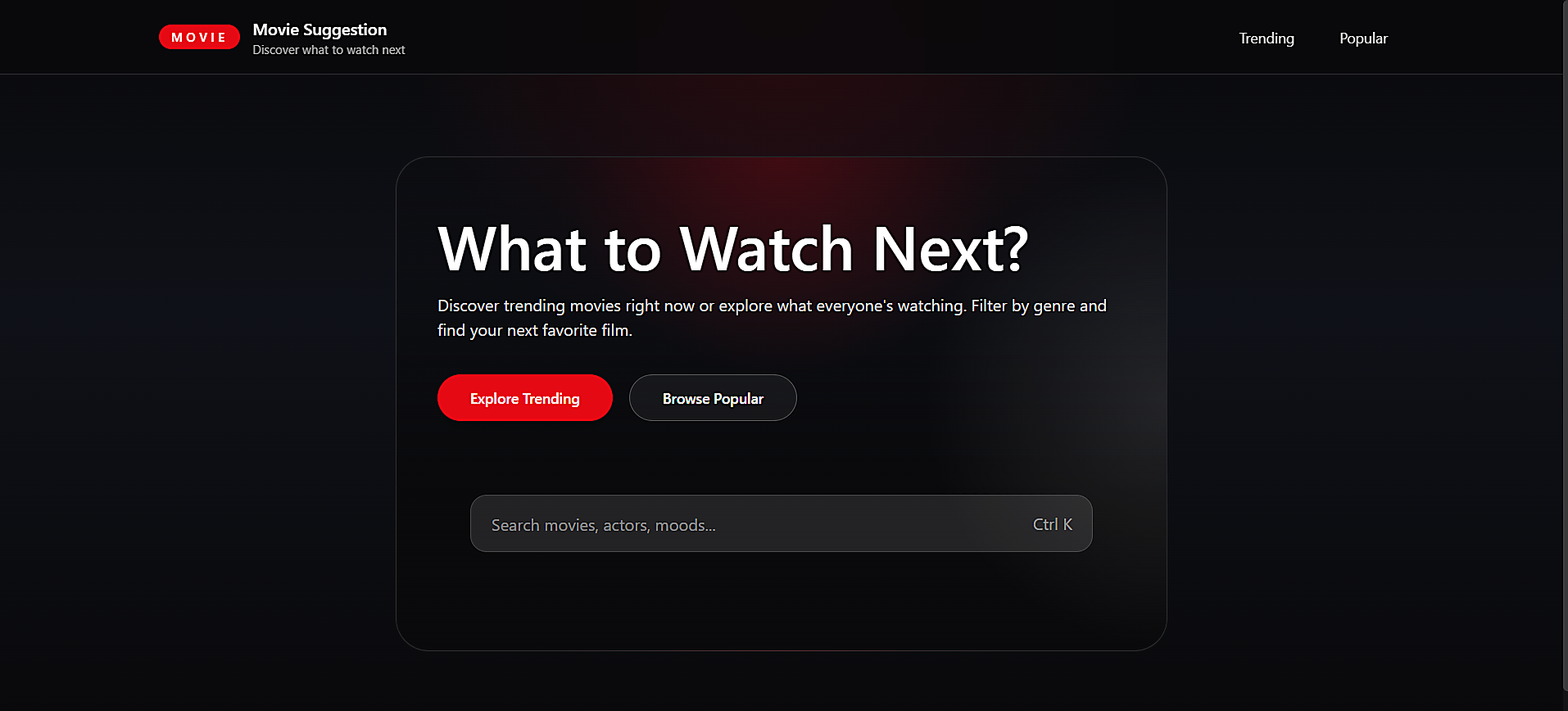
The project was built around a familiar frustration: most users do not need every movie, they need a small set of good options that match the moment. Movie Suggestion treats this as a ranking and presentation problem instead of a simple search page.
The core experience is intentionally lightweight. A user expresses preferences, receives a curated set of recommendations, and can refine from there without facing a wall of filters.
The user selects preferences such as genre, mood, or viewing intent.
The app translates those preferences into query parameters or ranking criteria.
Movie data is fetched, filtered, and ordered for relevance.
The UI renders a short list of choices with enough metadata to support a decision.
Movie posters are visual-heavy assets, so sizing and lazy loading improve perceived speed.
Lightweight refinements can happen without forcing full page transitions.
Showing a focused set improves decision-making and reduces rendering work.
Recommendation requests need visible progress so latency does not feel like failure.
The first decision was how much preference input the user should provide before seeing value.
The prototype focused on fetching reliable metadata and rendering a clean result grid.
Filtering and ranking were refined so the experience felt closer to guidance than basic search.
Final polish focused on responsiveness, visual consistency, and a fast exploration loop.
One of the most frustrating parts of the build was dealing with movie API rate limits while testing recommendation flows. Repeated searches, filter changes, and poster lookups could quickly hit request ceilings, so the app needed a more careful request strategy: avoid unnecessary refetches, reuse already-fetched results where possible, limit how many movies are requested at once, and design the UI so users still get useful feedback when the API slows down or refuses a request.
Movie APIs can return missing posters or metadata, so the UI needs fallbacks.
Ranking rules need to support user intent, not just raw popularity.
Profiles would let the app learn from previous choices instead of starting over each session.
Availability filters would make recommendations immediately actionable.
Showing why a movie was recommended would build trust in the ranking.
Movie Suggestion is a compact project with a clear product lesson: good discovery is not about showing more choices, it is about helping the user make a better choice faster.